
DETERMINATION OF SOUND ABSORPTION COEFFICIENT USING THE IMPEDANCE TUBE METHOD (ISO 10534-2)
General
The acoustic absorption coefficient of a material is determined in an impedance tube according to ISO 10534-2:1998(E). Three tube diameters are used to cover as wide a frequency range as possible.
The test specimens are disc-shaped (circular cylinders), and the required specimen diameter depends on the frequency range. The method is particularly suitable for product development, where multiple materials are compared and the final product is optimized. The final product is most often tested according to ISO 354, for which Turku UAS offers accredited testing services.
Products to be tested
- Mineral and polymer wools, insulation materials, and foams
- Perforated panels
- Felts and fabrics
- Spray-applied coatings
The product can be tested either mounted against a backing or suspended, leaving an air gap of desired thickness behind it.
Sample size
Three specimens are measured for each product, and the average is reported. This is because the sample is small, and materials are rarely homogeneous. If the product is tested with multiple tube sizes, three specimens are measured for each tube size.
The specimen diameter is selected based on the desired frequency range:
- Tube diameter 100.0 mm: frequency range 50 – 1600 Hz (max sample thickness: 600 mm)
- Tube diameter 63.5 mm: frequency range 80 – 3150 Hz (max sample thickness: 400 mm)
- Tube diameter 29.0 mm: frequency range 250 – 6300 Hz (max sample thickness: 600 mm)
Values in parentheses indicate the maximum sample thickness.
The given frequencies are center frequencies of one-third octave bands, and results are reported in one-third octave bands unless otherwise agreed.
For soft materials, the specimen diameter equals the tube diameter. For rigid materials, the specimen diameter is 0.20 mm smaller than the tube diameter.
To measure the frequency range 50–6300 Hz, three specimens of 29 mm diameter and three specimens of 100 mm diameter are required, totaling 6 specimens.
Sample preparation
The specimen is cut into a disc shape, for example using water jet cutting. Turku UAS can provide sample cutting as a subcontracted service.
Test method
The test specimen is placed inside the impedance tube. A loudspeaker mounted at the other end of the tube generates the test signal. The sound travels through the tube from the speaker to the specimen. The interaction of the incident and reflected sound waves is measured using microphones inside the tube. From these measurements, the acoustic absorption coefficient of the specimen is determined at normal incidence.
The result is reported as the absorption coefficient in one-third octave bands. Based on the absorption coefficient, the product’s absorption class (A-E) can be determined according to ISO 11654, if needed.
Comparison of test results with ISO 354
The results obtained using the tube method described here apply to normal incidence, i.e., when sound strikes the product surface perpendicularly. At low and mid frequencies, the absorption coefficients obtained with the tube method are somewhat or significantly lower than those obtained with the reverberation room method (ISO 354), because the latter also accounts for sound arriving at oblique angles. However, the tube method allows reliable comparison between materials and helps select the best option for further development. The best-performing material should be tested using the reverberation room method.
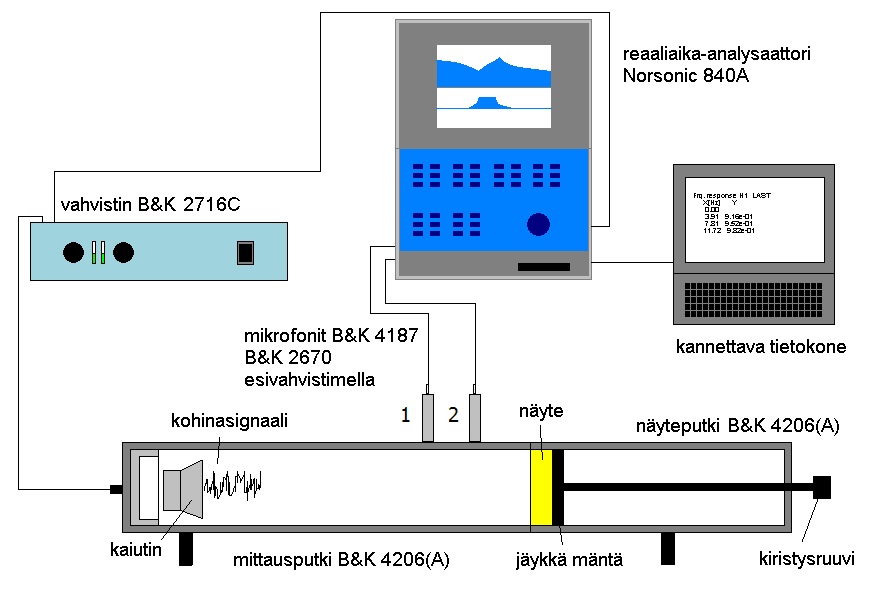
Figure 1. Schematic diagram of the measurement setup.
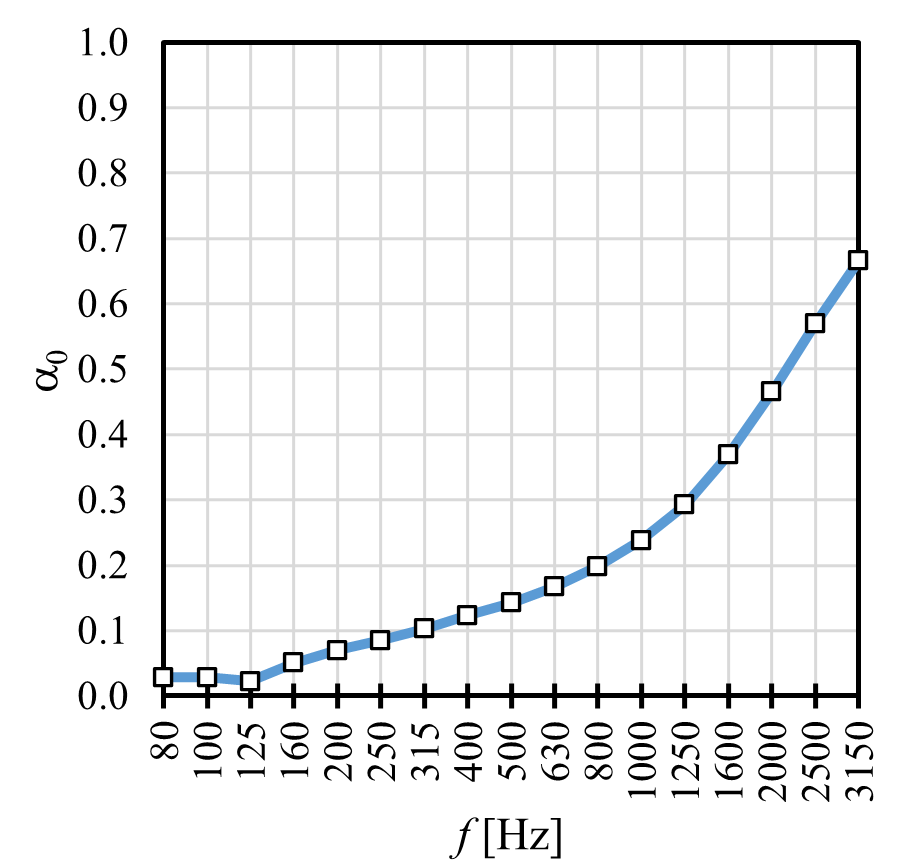
Figure 2. Example of test results for a product with a diameter of 63.50 mm. The graph shows the normal incidence absorption coefficient α₀ as a function of frequency f.
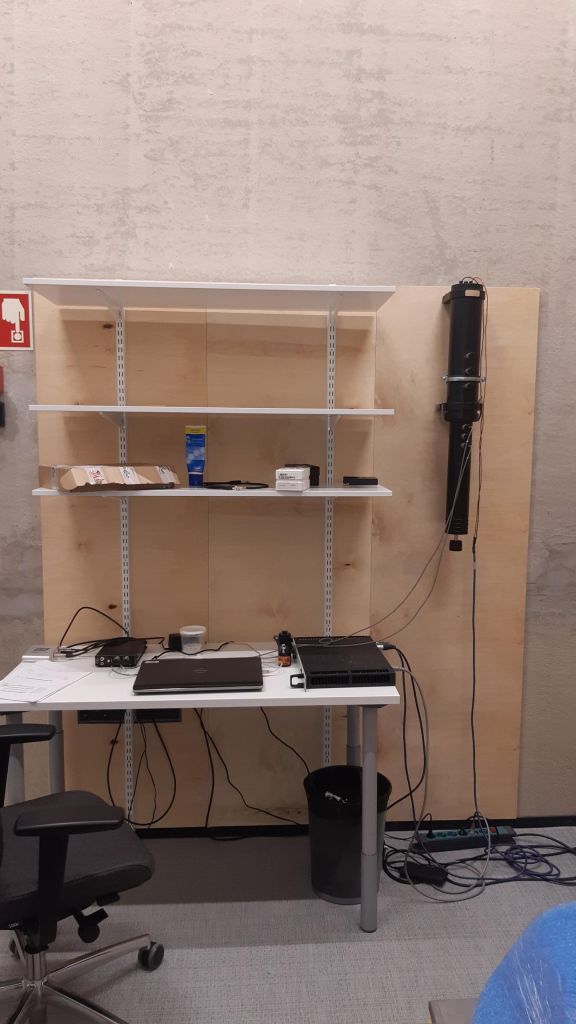
Figure 3. Measurement environment.
Our research on the topic
- Oliva, D., Hongisto, V. (2013). Sound absorption of porous materials – Accuracy of existing prediction methods, Applied Acoustics 74, 1473–1479.
- Oliva, D., Keränen, J., Hongisto, V. (2010). Absorption modelling of multilayer constructions, Proceedings of Baltic-Nordic Acoustical Meeting NAM 2010, 10–12 May, Bergen, Norway.
- Oliva, D., Häggblom, H., Keränen, J., Virjonen, P., Hongisto, V. (2008). Parametric study of layered absorption materials, Joint Baltic-Nordic Acoustics Meeting BNAM 2008, 17–19 August, Reykjavik, Iceland.
- Oliva, D., Häggblom, H., Hongisto, V. (2010). Sound absorption of multi-layer structures – experimental study, Indoor Environment Laboratory, Turku, Finnish Institute of Occupational Health, Helsinki, Finland.
Delivery and Location
The laboratory is located at Joukahaisenkatu 7, 20520 Turku. Instructions for deliveries can be found here.