
LISTENING TESTS: PRODUCT SOUND QUALITY DEVELOPMENT
Why Psychoacoustics?
Sound is an inseparable part of many products, and developing a controlled soundscape is a natural part of product development. Perceived sound quality cannot be determined with a sound level meter because sound involves many unique characteristics.
Turku University of Applied Sciences offers listening tests, psychoacoustic metric calculation services, and other sound quality-related consulting to support product development.
Psychoacoustic Metrics
Our service includes, for example, the following metrics:
- Tonality or narrowband characteristics (ISO 1996-2:2007 and IEC 61400-11:2012)
- Impulsiveness (Nordtest NT ACOU 112)
- Fluctuation strength, roughness
- Sharpness
- Variability
- Speech Transmission Index STI (IEC 60268-16:2011)
These metrics can be used to assess the annoyance of sound using calculation models, some of which have been developed in our laboratory.
Listening Tests
Sound quality, such as annoyance or pleasantness, is a subjective experience, and acoustic metrics alone cannot fully describe the perceived sound quality of a product. Listening tests conducted by a panel provide insights into product sound quality that objective measurements cannot capture.
We offer companies a full-service listening test package. A listening test may include sound recording, calculation of acoustic metrics, sound processing, the listening test itself, analysis of results, and reporting. We tailor the service to the client’s needs. Typical clients include companies in the construction or automotive industries.
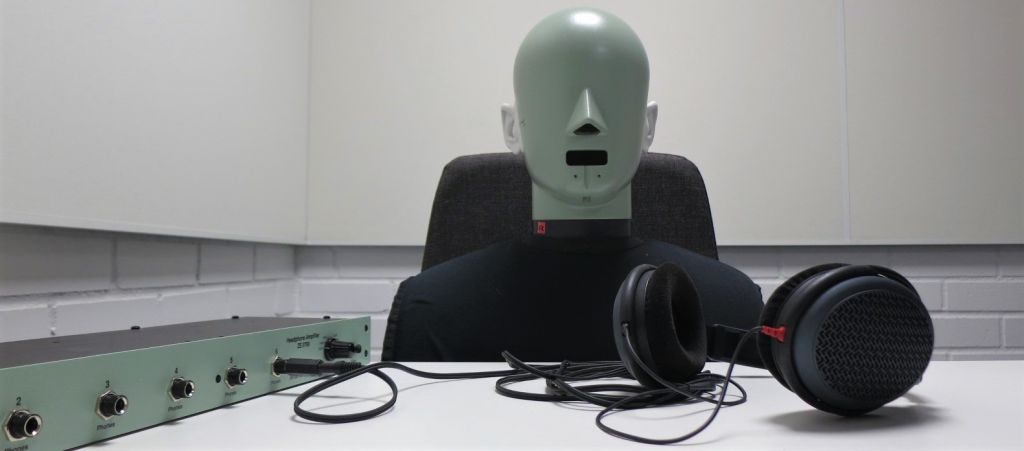
We can record product sounds either in the field or in our laboratory facilities. Our labs enable, for example, recording of impact sounds from different floor structures. We also have an anechoic chamber suitable for recording sounds from electrical devices. Our equipment includes, for instance, a dummy head for realistic binaural recordings. We can also conduct listening tests using recordings provided by the client.
We offer sound processing for recordings. Sound processing allows us to explore different soundscape options for a product without the need to build multiple prototypes.
In a listening test, a panel of 5-10 people evaluates a specific characteristic of the sound played to them. The characteristic may be noise annoyance, pleasantness, or distinctiveness in other environmental noise. We customize the test according to the client’s requirements. Our quiet listening rooms (LAeq < 16 dB) also enable tests with very low-level sounds.
We have years of experience in scientific research and product development related to listening tests. We have the necessary equipment and software ready, so we can deliver listening test results even on a tight schedule.
Scientific Publications by the Research Group
Sound quality metrics
Kuusinen, A., Rantanen, E., Hongisto, V. (2023). Annoyance penalty due to the spectrum shape of wideband noise. Building and Environment 250C 111163. Open access: https://doi.org/10.1016/j.buildenv.2024.111163.
Rajala, V., Hongisto, V. (2020). Annoyance penalty of impulsive noise – the effect of impulse onset. Building and Environment 168, 106539.
Virjonen, P., Hongisto, V., Radun, J. (2019). Annoyance penalty of periodically amplitude-modulated wide-band sound. The Journal of the Acoustical Society of America, 146(6) 4159–4170.
Hongisto, V., Saarinen, P., Oliva, D. (2019). Annoyance of low-level tonal sounds – A penalty model. Applied Acoustics 145 358–361.
Oliva, D., Hongisto, V., Haapakangas, A. (2017). Annoyance of low-level tonal sounds – factors affecting the penalty, Building and Environment, 123 404–414.
Hongisto, V., Oliva, D., Rekola, L. (2015). Subjective and Objective Rating of Spectrally Different Pseudorandom Noises – Implications for Speech Masking Design, The Journal of the Acoustical Society of America, 137(3) 1344–1355.
Building acoustics metrics
Hongisto, V., Laukka, J., Alakoivu, R., Virtanen, J., Hakala, J., Linderholt, A., Jarnerö, K., Olsson, J., Keränen, J. (2023). Suitability of standardized single-number ratings of impact sound insulation for wooden floors – Psychoacoustic experiment. Building and Environment 244 110727. Open access: https://doi.org/10.1016/j.buildenv.2023.110727.
Hongisto, V., Virjonen, P., Maula, H., Saarinen, P., Radun, J. (2020). Impact sound insulation of floating floors: A psychoacoustic experiment linking standard objective rating and subjective perception. Building and Environment. https://doi.org/10.1016/j.buildenv.2020.107225.
Hongisto, V., Oliva, D., Rekola, L. (2018). Subjective and objective rating of the sound insulation of residential building façades against road traffic noise. The Journal of the Acoustical Society of America, 144(2) 1100–1112.
Kylliäinen, M., Hongisto, V., Oliva, D., Rekola, L. (2017). Subjective and objective rating of impact sound insulation of a concrete floor with various coverings – a laboratory listening experiment, Acta Acustica united with Acustica, 103 236–251.
Hongisto, V., Oliva, D., Keränen, J. (2014). Subjective and objective rating of airborne sound insulation – living sounds, Acta Acustica united with Acustica 100 848–863.
Audiological research
Rajala, V., Hakala, J., Alakoivu, R., Koskela, V., Hongisto, V. (2022). Hearing threshold, loudness, and annoyance of infrasonic versus non-infrasonic frequencies. Applied Acoustics 198 108981 13+6 pp. Open access at: https://doi.org/10.1016/j.apacoust.2022.108981.
| Example of a Product Development Project
A company is developing a new product. The noise produced by the prototypes varies. The company wants to know which prototype’s sound customers would find the least annoying. In such a situation, the commissioned study may include:
We always tailor listening tests to the client’s specific needs. |