
FLOW NOISE TESTING OF VENTILATION DUCT PRODUCTS
Why
Every ventilation duct product generates noise when air flows through it. The least noise is produced in a straight, smooth-surfaced duct, and this is usually not taken into account. Significant noise can be generated by other duct products (see list below), especially if they cause high pressure loss and the airflow rate is large. Since there are guideline values for the A-weighted equivalent sound pressure level (LAeq) of ventilation noise for both indoor and outdoor environments (YM 796/2017, STM 545/2015), the sound level caused by duct products must be known. It is always determined by calculation and verified by measurements after the building is completed. The calculations are based on noise emission data obtained from laboratory measurements. These data shall be included in the product specification of the duct product.
Products to be tested
- Fans (sound into the duct or through the casing into the room)
- Control devices (damper, iris, IMS, etc.)
- Terminal devices
- Filters
- Transfer air devices
- Grilles and screens
- Snow guards
- Bends
- Silencers
Test method
The sound power level of duct products is determined according to ISO 5135 using the reverberation room method. Air volume flow measurements are performed according to ISO 5167 using calibrated orifice plates.
Figure 1 shows an example of a measurement setup used to determine the sound power level of an exhaust air terminal device. The sound pressure level was measured in Room 3. The airflow was generated by a fan located in Room 1, with high-performance silencers on both sides to prevent fan noise from reaching Room 3.
The laboratory is equipped with a fan capable of producing airflow rates between 20–2500 l/s.
The laboratory can reliably determine the flow noise of duct products intended for demanding applications (e.g. concert halls, auditoriums), as the background noise level is extremely low: 17 dB LAeq. The lowest measurable sound power level is 22 dB LWA.
The flow noise emission of a duct product is determined at several different flow velocities. Using linear regression on the results, the flow noise emission can be reliably determined at any flow velocity by interpolation or extrapolation.
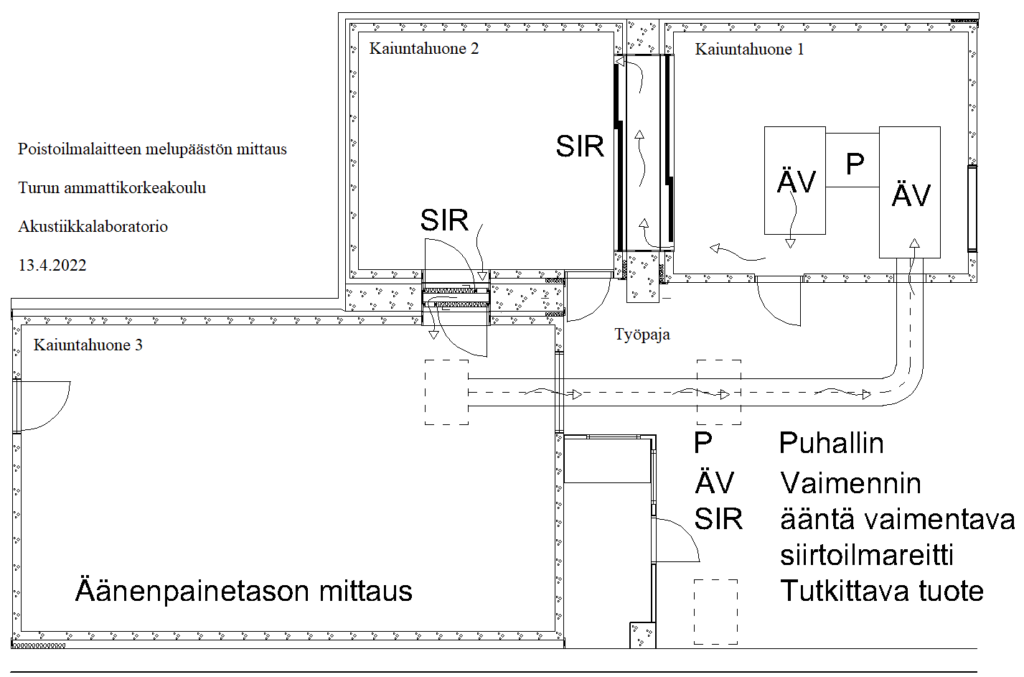
Figure 1. Example of flow noise measurement for an exhaust air terminal device.
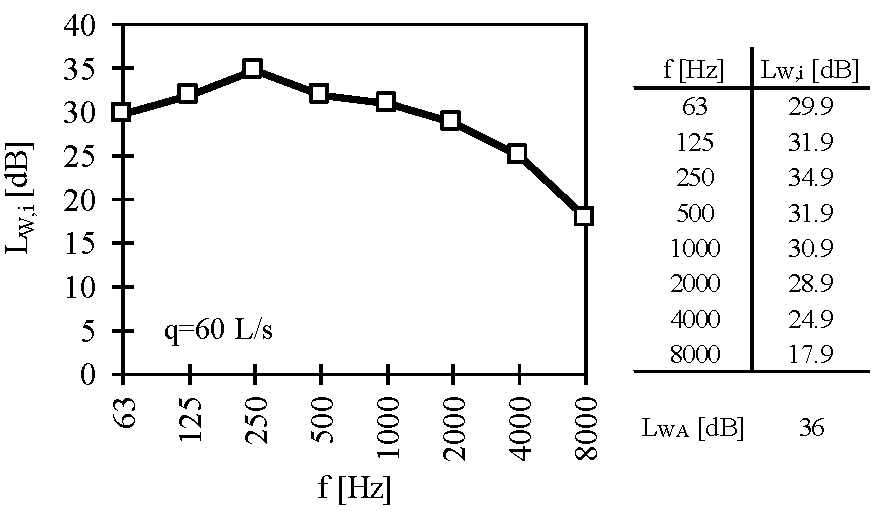
Figure 2. Example of a measurement result of the sound power level (LW,i, dB) of an exhaust air terminal device at a single airflow rate across octave bands 63–8000 Hz. Additionally, the A-weighted total sound power level LW,A is presented.
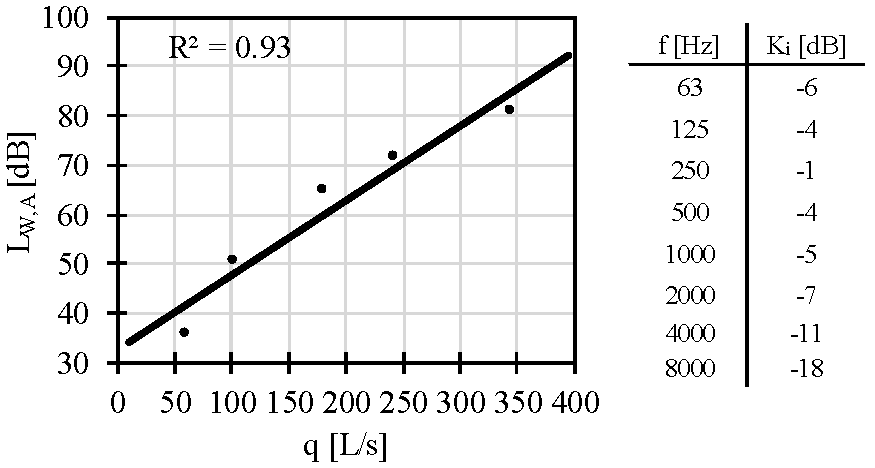
Figure 3. Example of results compiled for the product specification of an exhaust air terminal device. The device in question had no adjustment functionality. On the left, measurement results are shown as data points along with a fitted curve based on those results. The sound power level LW,i for octave band i is calculated using the formula LW,i = LW,A +Ki. The value of LWA is selected from the fitted curve according to the airflow rate
Delivery and Location
The laboratory is located at Joukahaisenkatu 7, 20520 Turku. Instructions for deliveries can be found here.