
DYNAMIC STIFFNESS OF RESILIENT FLOORING UNDERLAY MATERIALS
Purpose of the Test
Floating floors are commonly used on top of load-bearing floors to improve impact sound insulation. These constructions may also incorporate underfloor heating systems. A resilient underlay material is placed between the load-bearing floor and the floating screed or board layer.
Products to Be Tested
Typical examples of products tested include:
- Mineral wool
- Glass wool
- Polymer-based materials
- Underlay materials with integrated heating pipe systems
- Underlay products for parquet or laminate flooring
Sample Size for Measurement
Three specimens of each product are required, each measuring 200 x 200 mm. A single sample is not sufficient due to material inhomogeneity.
Test Method
The test is performed in accordance with ISO 9052-1. The specimen is placed beneath a steel loading plate. When the plate is excited from above with vibration, the system comprising the floor, resilient material, and loading plate forms a mass-spring-mass system that resonates at a characteristic frequency. This resonance frequency is measured and used to calculate the dynamic stiffness per unit area, denoted as s′ [N/m³], of the resilient material.
If the material is porous, air may escape from the sample during the test due to its small size. However, when installed under a floor, the air is confined and contributes to the overall stiffness of the system. To account for this, the airflow resistance of the material is determined according to ISO 9053. Airflow resistance is always measured alongside dynamic stiffness to assess whether the dynamic stiffness of the entrapped air should be included in the final result.
Application of Results
The results are used in the characterization and development of floating floor systems. The dynamic stiffness value can be used to calculate the resonance frequency of the floating floor. Lower dynamic stiffness values result in lower resonance frequencies, which typically lead to improved sound insulation performance.
There are no fixed limit values for dynamic stiffness or resonance frequency. Floor structures are designed to meet the target values for impact and airborne sound insulation.
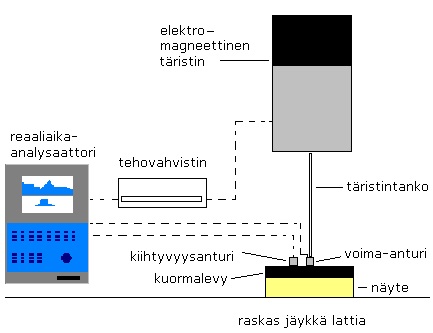
Figure 1. Schematic diagram of the test setup.
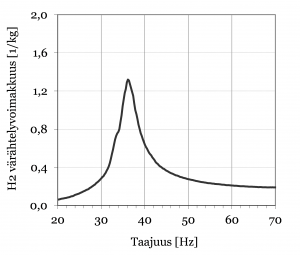
Figure 2. Example of a measured resonance frequency (36 Hz) for a resilient mineral wool underlay. The corresponding dynamic stiffness is s′ = 16 MN/m³, taking into account the dynamic stiffness of the air in the pores.
Delivery and Location
The laboratory is located at Joukahaisenkatu 7, 20520 Turku. Instructions for deliveries can be found here.